The Executive Eraser: Does Article II Permit a President to Pardon Himself?
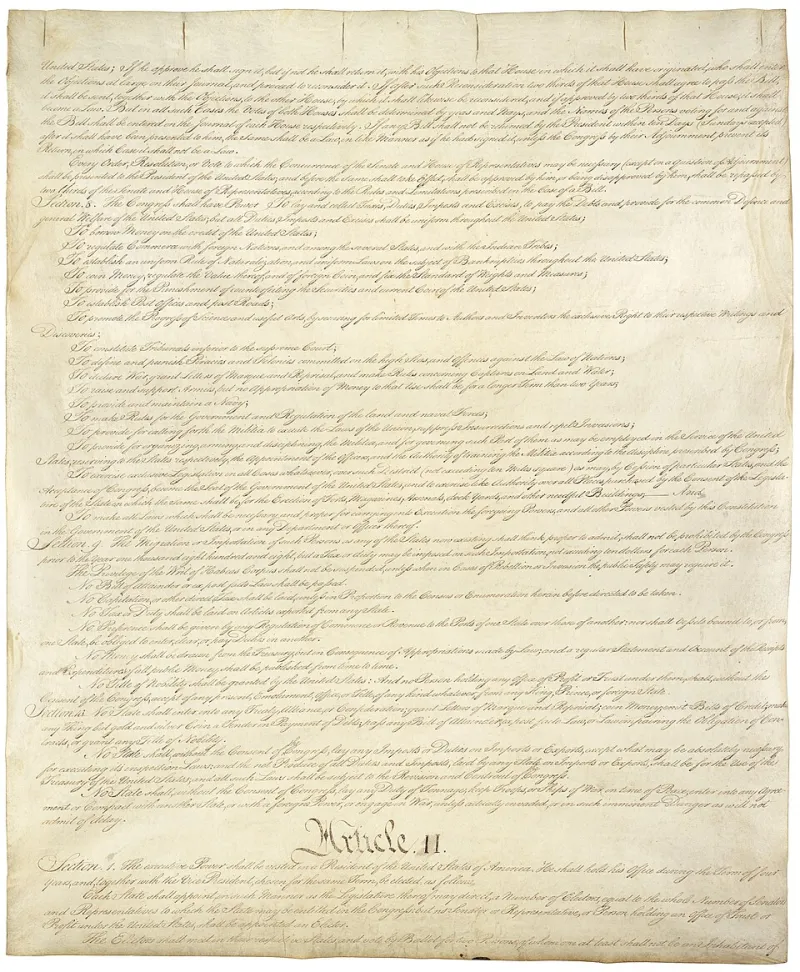
Photo: Constitutional Convention, Public domain, via Wikimedia Commons
Few clauses in the Constitution read as broadly as the one tucked into Article II, Section 2. The President, it says, “shall have Power to grant Reprieves and Pardons for Offenses against the United States, except in Cases of Impeachment.” Nothing in that sentence names a recipient. Nothing in it names a limitation on who may benefit. And in nearly two and a half centuries of practice, no president has issued a pardon to himself—which means the question has been argued in memoranda, law review pages, and confirmation hearings, but never resolved by the branch that would have to decide it.
The renewed public interest in that question is not an accident of the calendar. Whenever executive power becomes the central subject of American politics, the pardon clause follows, because it is the sharpest instrument in the office. A president who can erase federal consequences for another person can, in principle, erase them for himself. Whether he may is the harder issue.
What the Words Do and Do Not Say
On the surface, the text is silent about self-pardons. That silence cuts in two directions, and honest interpreters concede as much.
The negative implication runs like this: the Framers knew how to list exceptions, and they listed exactly one—cases of impeachment. If they had wanted to add “and the President may not pardon himself,” they could have. The power granted in Ex parte Garland (1866) was described by the Court as “unlimited” except where the Constitution itself restricts it, and Congress cannot narrow it by statute. Any limitation invented by inference, the argument goes, is a limitation invented by whoever happens to hold the pen.
The negative implication cuts the other way, though, once the verb is examined. To grant is to transfer something to someone; a grant presupposes a grantor and a grantee, and the President is, in every ordinary English sentence, the former. The structure of Article II reinforces the point: the President is a branch of one, and the entire constitutional architecture of checks rests on the premise that no officer judges his own cause. Alexander Hamilton, defending the power in Federalist No. 74, treated it as an act of mercy toward others—a device to soften justice tempered by too much severity, useful in seasons of insurrection. Mercy that runs inward is a different concept, and the Federalist Papers do not contemplate it.
The English Inheritance
The Framers did not invent the pardon. They inherited it from the prerogative—and they inherited its limits along with it. Under English practice, the royal pardon could not be pleaded in bar of a parliamentary impeachment; the House of Commons retained, in Blackstone’s account, something close to a power of appeal in cases of great public misconduct. The Convention’s exception for impeachment is the American version of that rule, and it points to a principle broader than the clause: the political consequences of official misconduct are not the President’s to forgive.
That principle appears again in a maxim every first-year law student learns—nemo iudex in causa sua, no one a judge in his own case. It is not a slogan. It is the assumption on which the separation of powers is built, and it appears in the Constitution’s own text in the disqualification clause of Article I, Section 3, the emoluments clauses, and the prohibition on self-dealing that runs through Article II’s oath.
The 1974 Memorandum and the Argument That Followed
The most cited statement on the subject remains the August 1974 opinion of the Office of Legal Counsel. Written as the Watergate investigation closed in, it concluded that a president may not pardon himself, reasoning from the rule that no one may be the judge in his own case and adding a notably practical corollary: if a president faced a genuine incapacity, the Twenty-Fifth Amendment offered a lawful path—transfer the powers, obtain the pardon from the person exercising them, and proceed.
That advice has been reaffirmed in later years, but never tested in litigation, and a departmental opinion binds no court. Its significance is institutional rather than judicial: it reflects what the executive branch itself has understood its own authority to be, and that understanding is relevant even to interpreters who do not treat it as controlling.
What a Self-Pardon Could Not Do
Even under the most expansive reading, a self-pardon is a smaller act than it first appears. Four limits survive any version of the argument.
First, the power reaches only offenses against the United States. State prosecutions, state investigations, and state civil suits are untouched; a defendant in a New York courtroom cannot wave an Article II document at a state judge.
Second, the impeachment exception is a wall, not a gate. A pardon cannot prevent the House from impeaching or the Senate from convicting, and it cannot bar conviction’s separate consequence—disqualification from future office. Impeachment does not require a crime, so removing the crime from the board removes nothing from the proceedings.
Third, a pardon must generally be accepted, and the Supreme Court held in Burdick v. United States (1915) that acceptance carries an acknowledgment of guilt. A self-pardon is, in that sense, a confession-shaped document: it resolves the legal exposure by narrating the facts.
Fourth, the pardon is a shield against criminal liability, not a solvent for every legal obligation. Civil proceedings, congressional subpoenas, regulatory consequences, and the court of public judgment all remain. The pardon clause is not an eraser; it is a narrow instrument that reaches one particular kind of consequence.
The Courtroom It Would Have to Survive
Critics sometimes imagine the question will arrive as an abstract suit—a congressman or a watchdog suing for a declaratory judgment. That is unlikely to work; federal courts require a concrete case or controversy, and the political question doctrine, while rarely invoked, has been used to keep some interbranch disputes out of court entirely. The realistic vehicle is far more ordinary: a federal prosecution, a motion to dismiss, and a judge who must decide whether a pardon asserted as a bar is valid. That is a merits question, and it is one the judiciary would probably have to answer if it was ever squarely presented.
What Congress Can and Cannot Do
Here the constitutional structure is more restrictive than most commentators assume. Congress cannot simply legislate a limit on the pardon power; United States v. Klein (1872) held that the legislative branch may not attach conditions that impair a power the Constitution has vested elsewhere. A statute requiring pre-clearance, mandatory disclosure, or a waiting period would almost certainly face that objection, even if a disclosure requirement tied only to reporting is on firmer footing.
What Congress can do is largely political and structural: propose a constitutional amendment, a slow and uncertain project but the cleanest answer; exercise its own impeachment and disqualification authority; and shape the surrounding legal landscape—the scope of federal offenses, the independence of investigators, the record-keeping obligations of the executive branch.
A Question About the Mirror
The self-pardon debate is often reduced to a textual puzzle, but the text is genuinely underdetermined, and the resolution depends on what kind of government the Constitution is understood to create. A document that divides power on the premise that ambition must counteract ambition does not easily yield a reading in which the chief magistrate is the final judge of his own guilt. Nor does it easily yield a reading that permits the office to be used as a personal instrument of absolution.
What remains is a genuine tension between an enumerated power and an unwritten structural principle, and no court has had to choose. When — or if — that choice comes, it will not be settled by grammar. It will be settled by whether the men and women who wrote Article II are read as having granted a prerogative or as having created an office.