The Text of the Promise: Article VI, the Oath Requirement, and the Boundaries of Official Loyalty
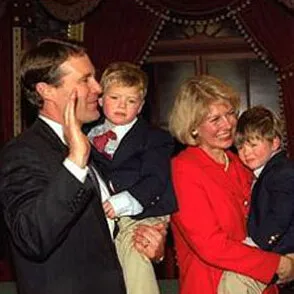
Photo: Office of Senator Evan Bayh, Public domain, via Wikimedia Commons
Every few years, a public controversy sends citizens back to a sentence most of them have never read closely. Article VI, Clause 3 provides that senators and representatives, members of the state legislatures, and all executive and judicial officers of both the United States and the several states "shall be bound by Oath or Affirmation, to support this Constitution." It is the only place in the original document where the word "oath" appears. It is also, by design, one of the least elaborate provisions in the text—a fact that explains both its durability and its persistent ambiguity.
A Clause Born From Distrust
The Framers did not invent official oaths. Colonial and state governments had long required them, and the Articles of Confederation obligated delegates to swear allegiance to the union. What the Convention did in 1787 was narrower and more pointed. Rather than demanding loyalty to a legislature, a governor, or even to the national government as an institution, the clause fixes the object of the promise on the Constitution itself.
That choice carried a specific meaning for a generation wary of pledged allegiance to distant authority. The oath binds an officer to a text and a structure, not to a person or a party. Equally important is what the clause omits. The very next sentence forbids any religious test as a qualification for office—a prohibition that was, in 1787, more radical than the oath requirement itself, and which later became the basis for the Supreme Court's holding in Torcaso v. Watkins (1961) that a state may not condition officeholding on a belief in God.
Support, Not Obedience
One reason the Oath Clause resists easy application is its verb. The Constitution does not ask officers to "obey" it, nor to "defend" it in the martial sense, nor to agree with any particular reading of it. The word chosen was "support."
That distinction matters in practice. Federal law gives the requirement concrete form: 5 U.S.C. § 3331 prescribes the familiar fourteen-word oath administered to members of Congress, federal judges, and executive officers. Military commissions and state constitutions add their own variations. But no statute defines what supporting the Constitution requires when the document is contested—and it is always contested, which is the ordinary condition of constitutional government rather than a sign of its failure.
An official who votes for a bill later held unconstitutional has not thereby breached an oath. Neither has a judge whose interpretation is reversed on appeal. If every losing constitutional argument were a violation of Article VI, the clause would convert ordinary disagreement into misconduct and swamp the very institutions it protects. The text, in other words, points toward a duty of fidelity to the constitutional order—its processes, its limits, its mechanisms for correction—rather than to a duty of agreement with any single interpretation.
The Nineteenth-Century Testing Grounds
The clause's most searching nineteenth-century examination came after the Civil War. In Ex parte Garland (1867) and Cummings v. Missouri (1867), the Supreme Court struck down test oaths that barred former Confederates from practicing law and the clergy, reasoning that the measures were bills of attainder and ex post facto laws dressed as loyalty requirements. The cases stand for a proposition still worth restating: the government may require a promise, but it may not use the promise as a device to punish past conduct or to screen out disfavored classes of citizens.
That principle does not leave the oath toothless. It simply confines its enforcement to the structures the Constitution itself supplies.
Two Different Questions in 2026
Contemporary debates tend to blur two distinct inquiries. The first concerns the oath: what does an official's promise to support the Constitution obligate in a given dispute? The second concerns disqualification: whether a specific individual is barred from holding office under Section 3 of the Fourteenth Amendment, which addresses insurrection or rebellion and is enforced through congressional action. In Trump v. Anderson (2024), the Supreme Court held that states may not enforce Section 3 against federal candidates absent federal legislation—a decision about enforcement mechanics, not about the meaning of the oath.
The distinction is not semantic. The oath is a forward-looking commitment made by everyone who takes office. Section 3 is a retrospective bar applicable to a narrow category of conduct. Conflating them invites citizens to treat political opposition as perjury and to expect courts to resolve what are, at bottom, questions of judgment entrusted to voters and to the political branches.
What Citizens Can Reasonably Expect
A useful citizen's test is to ask three questions of any oath controversy. First, what specific constitutional provision is said to be violated, and by what action? Second, which institution has been assigned the authority to make that determination? Third, what remedy does the Constitution itself contemplate?
Applied honestly, those questions tend to deflate the most heated claims while confirming the clause's real work. The oath is a public act of commitment that binds officials to a common framework above their own preferences. It is a reminder that the Constitution is not merely a set of constraints imposed on others but a discipline accepted by those who govern.
That is a modest function, and the Framers seem to have intended it that way. Article VI does not tell officials how to resolve hard constitutional questions. It tells them that they must resolve those questions within the constitutional system, and that they answer for the result to the public that placed them in office. In an era quick to accuse and quick to absolve, that unglamorous instruction may be the clause's most valuable contribution.