Nine Is a Habit: How Congress Fixed the Supreme Court's Size—and Why 2026 Is Reopening the Question
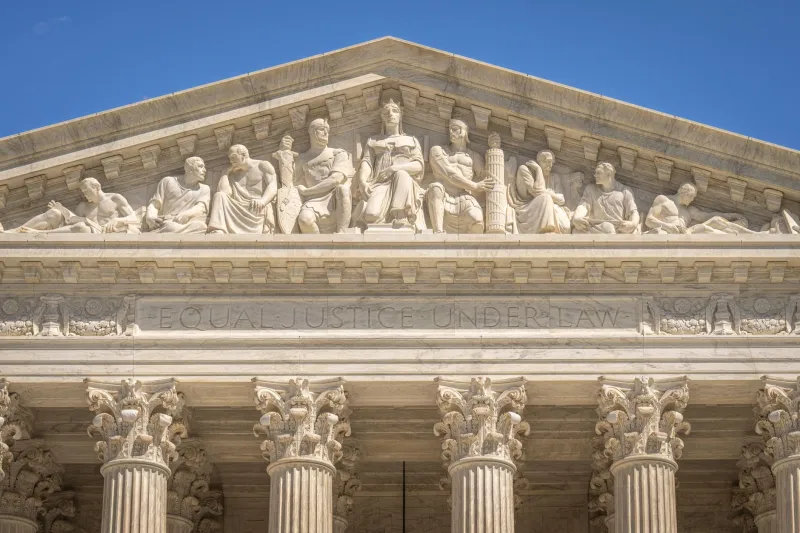
Americans talk about the Supreme Court's nine seats as though the number were etched into parchment at Independence Hall. It is not. Article III of the Constitution creates 'one supreme Court' and gives Congress authority to establish inferior tribunals, but it never says how many justices should serve. The nine is a congressional habit, adopted in 1869 and never changed. That history matters in 2026 because proposals to enlarge the bench are no longer merely academic. They raise a structural question the Framers left open: who decides how large the federal judiciary's top tier should be, and on what principle?
What Article III Does—and Does Not—Say
Section 1 of Article III vests the judicial power of the United States in 'one supreme Court' and in such inferior courts as Congress may 'from time to time ordain and establish.' It guarantees judges tenure during good behavior and protects their compensation from reduction. It says nothing about the number of justices, the number of circuits, or the size of the docket. That silence was not a constitutional oversight so much as a delegation. The Framers created a framework, not an administrative manual, and they left the details to the representative branches.
Alexander Hamilton, writing in Federalist No. 78, described the judiciary as the 'least dangerous' branch because it possesses neither the sword nor the purse. But Hamilton also understood that Congress would shape the courts through legislation. The first Congress did exactly that. The Judiciary Act of 1789 set the Supreme Court at six members—one chief justice and five associate justices—and established the lower federal courts. From the beginning, the size of the Court was a policy choice, not a constitutional command.
From Six to Nine: A Statute-by-Statute History
The Court's early history is a record of frequent adjustment. Congress reduced the Court to five justices in 1801, then repealed that change a year later. It expanded to seven in 1807 as the nation added circuits, to nine in 1837, and to ten in 1863 during the Civil War. In 1866, Congress cut the Court to eight justices, partly to deny President Andrew Johnson the chance to fill vacancies. When Ulysses S. Grant took office, Congress restored nine in 1869. That number has held ever since.
This history matters for two reasons. First, it shows that court packing is not a modern invention. Congress has altered the Court's size for political and administrative reasons throughout American history. Second, it shows that the nine is not sacred. It is a statutory equilibrium, sustained by custom and political cost rather than by constitutional text.
The 1937 Precedent That Still Casts a Shadow
The most famous fight over Court size came in 1937, when President Franklin D. Roosevelt proposed the Judicial Procedures Reform Bill. The plan would have allowed the president to appoint an additional justice for each sitting justice over the age of seventy and a half, up to six new seats. Roosevelt framed the proposal as a response to an overworked Court and to decisions striking down New Deal legislation. Critics called it court packing, and the label stuck.
Congress rejected the bill, but the episode reshaped American politics. The Court began upholding New Deal programs, and the fight cemented a norm: enlarging the bench to secure a preferred ideological outcome is politically dangerous. That norm is not legally binding. It is a convention, enforced by public opinion, institutional loyalty, and the fear of retaliation. In 2026, any serious expansion proposal must reckon with that legacy.
The 2026 Argument for a Larger Court
The contemporary case for expansion rests less on any single bill than on a set of structural claims. Supporters argue that the Court's workload and the complexity of federal law have grown far beyond what nine justices can handle with care. They point to the shadow docket, the rise of emergency applications, and the Court's role in resolving national policy disputes. They also note that the federal judiciary has expanded below the Supreme Court while the top tier has remained fixed since 1869.
Some proposals would enlarge the Court to thirteen justices, roughly matching the number of federal appellate circuits. Others would create a rotating panel system or impose term limits. The constitutional argument is straightforward: Congress has the power to regulate the size of the Supreme Court, just as it did in 1789 and 1869. The political argument is harder. Expansion would be lawful, but lawful does not mean wise or stable.
The Counterargument: Norms, Retaliation, and Legitimacy
Opponents of expansion warn that changing the Court's size for partisan advantage would invite a tit-for-tat cycle. If one party adds seats when it controls Congress and the presidency, the other party may do the same when power shifts. The result could be a Court whose membership fluctuates with election outcomes, undermining the perception of judicial independence.
There is also a separation-of-powers concern. The Framers expected Congress to check the judiciary through impeachment, jurisdiction regulation, and the appointment process. Court expansion is another lever, but it is a blunt one. It does not merely check the Court; it reconstitutes it. That distinction matters in a constitutional system that depends as much on norms as on text.
A Separation-of-Powers Test, Not a Constitutional Crisis
In 2026, the debate over Court expansion is best understood as a stress test for the separation of powers. The Constitution permits Congress to change the number of justices. The president may nominate new justices, and the Senate may confirm them. The Court itself is unlikely to block such a law, because Article III gives Congress broad authority over the judiciary's structure. The real constraint is political, not constitutional.
That does not make the question easy. A larger Court might improve judicial capacity, or it might deepen partisan conflict. A smaller Court might preserve stability, or it might leave the bench overburdened. The Framers did not answer these questions because they could not. They left them to each generation, along with the obligation to exercise judgment rather than treat custom as command. Nine is a habit, not a constitutional rule. In 2026, the country is again deciding whether to keep it.